Resources
The ASAP Collaborative Research Network (CRN) is committed to creating resources that accelerate discovery and empower the broader scientific community. From shared datasets and protocols to open-access tools and training materials, our resources are designed to be widely accessible, reusable, and impactful.
By enabling resource and data sharing, we can improve process efficiency, reduce redundancy and costs related to tool development and data generation, enhance discourse around troubleshooting methods, and improve access to field-enabling research resources.
Explore how we are building a foundation for faster, more collaborative Parkinson’s research through the tools and knowledge we share.
Resource Teams
CRN Resource Teams provide essential tools, services, and shared resources to enable the CRN and ultimately strengthen the broader research community.

The CRN Cloud
The CRN Cloud was created for harmonized multi-omics, CRN-generated datasets, including single-cell sequencing data from human brain tissue from over 600 postmortem donor brains, making this the largest resource of this type. Through collaboration with the Allen Institute we are ensuring that these data sets can be visualized through the Allen Brain Cell (ABC) Atlas.
The Microbiome Analytics Core (MAC)
Through the Microbiome Analytics Core (MAC), we support the standardization of protocols and meta-analysis of microbiome data for PD. Within the first six months, the MAC pulled together ~70over 100 studies related to microbiome data into the BugSigDB platform, a more comprehensive curation of publications from 9 different datasets that will be used for future meta-analyses.
The Catalog

The ASAP Catalog is an open-access inventory showcasing the tools, datasets, protocols, key lab materials and code developed by CRN teams and other supported programs. It is designed to help researchers easily find and use resources that can advance Parkinson’s disease (PD) research.
The CRN continues to share their work, generating over 1,500 ASAP-funded research outputs. By making these resources freely available, the CRN supports a more open, efficient, and connected research community.
ASAP Tools and Resources
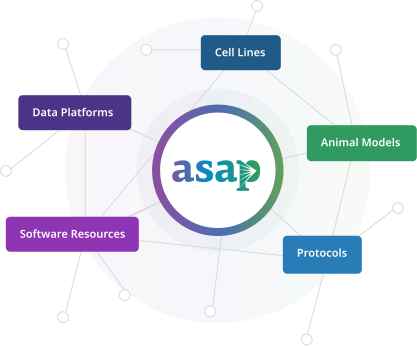
We offer a growing collection of open-access tools, datasets, and platforms developed to advance Parkinson’s research. These resources are designed to support our investigators and the broader scientific community by making cutting-edge methods and data widely available. By sharing these assets openly, we aim to accelerate discovery and foster greater collaboration across the field.
Resource Guides
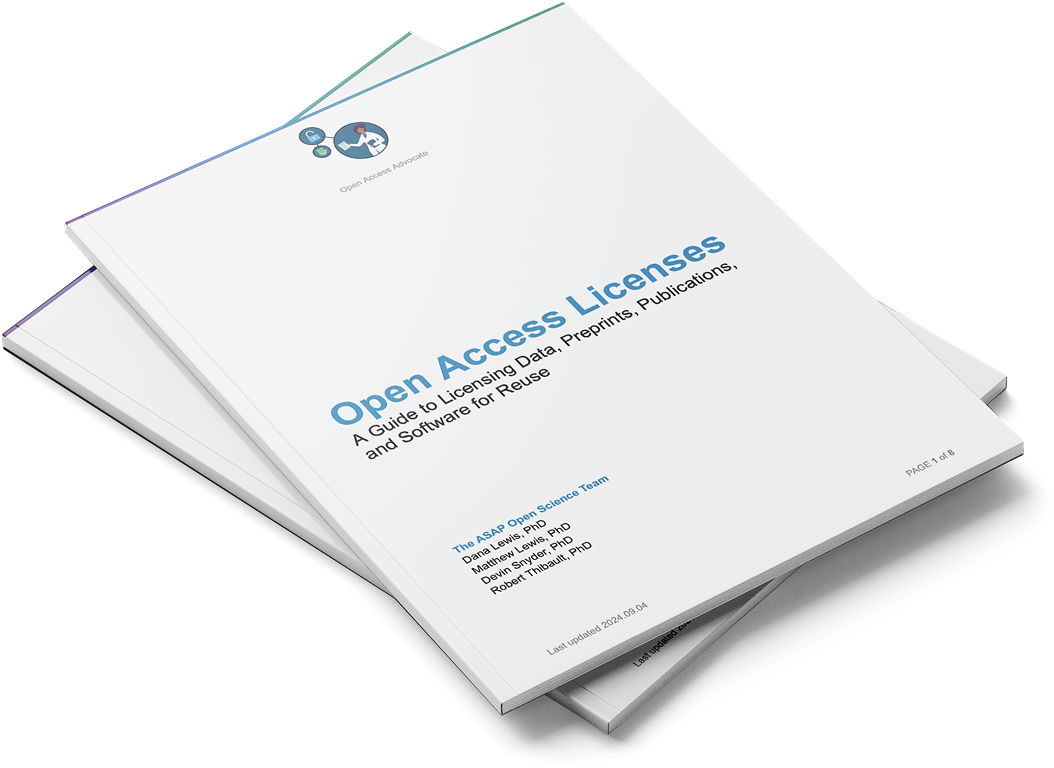
We have developed a series of resource guides to help researchers navigate the process of sharing tools, datasets, protocols, and more. These guides are designed to make it easier for the broader scientific community to ensure the resources they generate are widely accessible, reusable, and impactful.
CRN Discoveries
Continue to explore our discoveries across the CRN’s three original themes.
